

My mom loves Polish pottery. The creamy white and blue stoneware with the little dots and flowers, the plates that go from the oven to the table and then into the dishwasher. Matt and I had brought pieces home to her from an earlier trip, and until 2019 she had never seen where any of it came from.
It comes from one town. Boleslawiec, in southwest Poland, about seventy-five miles west of Wroclaw.
So when we took my parents to Germany and Poland for two weeks, I built a day of the drive around it. My dad Jake’s ancestry is German, my mom Marlene’s is Polish, and the whole trip was shaped around that. Boleslawiec was her half of it.
Here’s how to do the same thing, and what I’d tell you before you go.
Table of contents
Where Boleslawiec is and how to get there
Boleslawiec sits in Lower Silesia, in the southwest corner of Poland, close to the German border.
From Wroclaw it’s about seventy-five miles, an hour and a half by car. That’s the trip most people make, and there are three ways to do it.
By train, which is the one I’d take. Koleje Dolnoslaskie runs it from Wroclaw Glowny around twenty times a day and PKP Intercity runs it too. The fastest ones do it in about an hour, most take an hour and a half. If you’ve never bought a Polish train ticket before, I wrote up how not to overpay for European trains in my free guide How to Book Trains in Europe Without Overpaying.
By car, if you already have one. Renting for a single day just for this is usually not worth it unless there are three or four of you splitting it.
Or on an organized day trip from Wroclaw. Budget seven to eight hours rather than a half day, and read the description before you book, because most of them pair the pottery with the wooden Church of Peace at Jawor. That’s a good day, it just isn’t only pottery. Here are the day trips running from Wroclaw.
We came at it from the other direction. We had a rental car and we were driving from Cottbus, Germany, so we stopped in Boleslawiec on the way to Wroclaw rather than doubling back from it.
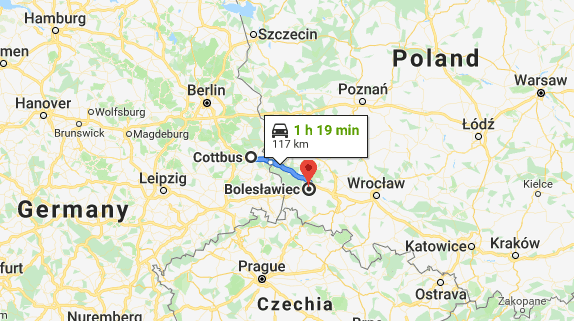
One thing that has changed since our trip, and it matters if you’re driving over from Germany. Both countries are in the Schengen area and in 2019 we crossed without stopping. That isn’t the situation now. Germany has been running checks on the Polish border since 2024 and Poland has been running its own going the other way, and the Olszyna crossing on the A18 is one of the named ones. Have your passport where you can reach it and don’t schedule the day tight around the crossing. Correct as of September 2026, and both sets of controls run on renewable terms that keep getting extended, so check the current position before you go.
Worth saying plainly: Matt and I go through that crossing on EU passports, so what we see in a border line is not what you’ll see. If you want the story of how we ended up with them, it’s in my free guide How We Got Dual Citizenship in the EU.
The road, and the good news
I have to tell you about the road, because it’s most of what I remember about getting there.

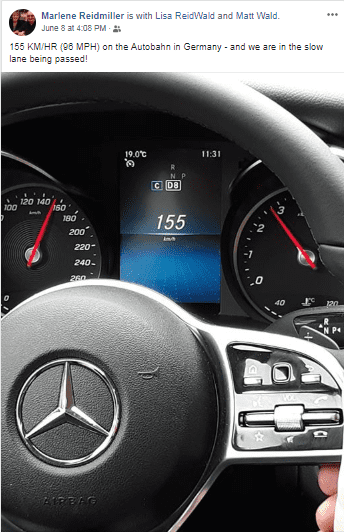
The German autobahn out of Cottbus was a superhighway with long stretches of no speed limit, and Matt had decided by then that he wanted to know what a loaded Mercedes wagon would do with four adults and their luggage in it. He found out. My mother, sitting in the back, took a photo of the dash and put it on Facebook while it was happening.
Then we crossed into Poland and the road turned into something else entirely.
The A18 was two very different roads back then. The side heading west was modern. The side we were on, heading east, was still the original concrete slabs laid in the 1930s. We dropped to about 60 kilometers an hour, under 40 miles an hour, and the car still bounced hard enough that my teeth rattled and I started to feel carsick. My dad made a crack about Polish road engineering that did not land well with my mom, though it was hard to argue with him at the time. I eventually found a way off it and we did the last twenty kilometers or so on back roads.
Here’s the good news, and it’s the reason I’m telling you all of this: that road is gone. The old slab carriageway was rebuilt from the German border at Olszyna through to Golnice, seventy kilometers of it, and the last section opened in October 2023. Everything you’d drive between Germany and Boleslawiec is new. The single worst part of our day is the one part you won’t have to do.
Lunch on the Rynek
Boleslawiec’s market square is small and pretty and takes about ten minutes to walk. Pastel townhouses, a pharmacy, a few shops, an archway you go through to get into it.
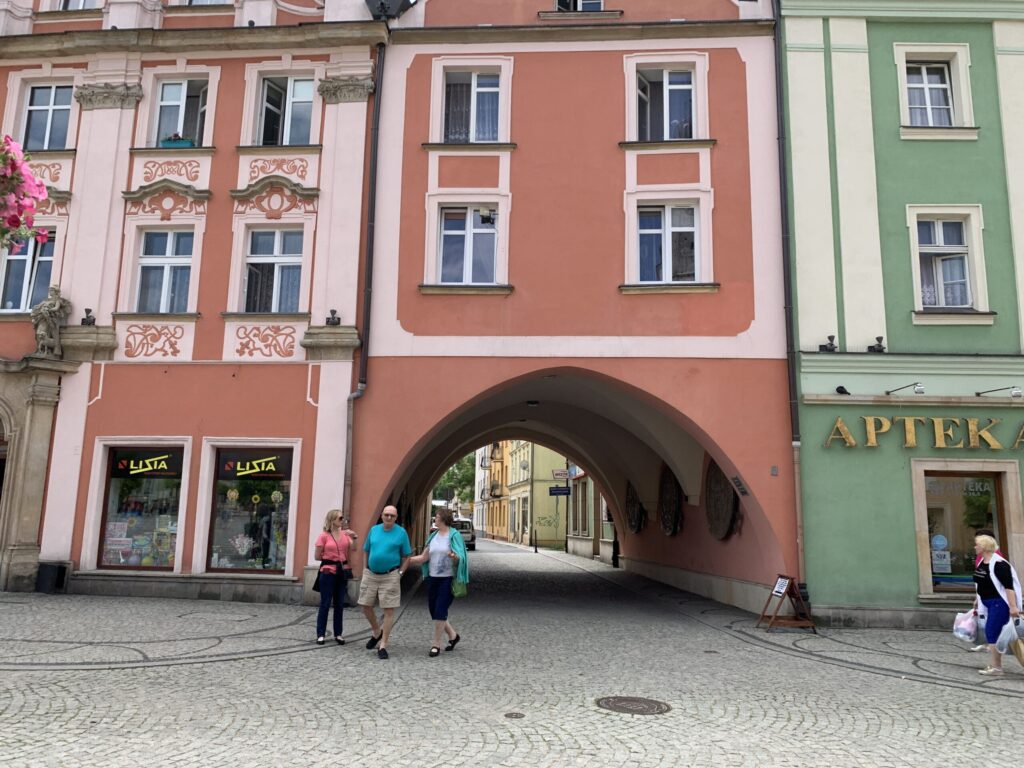
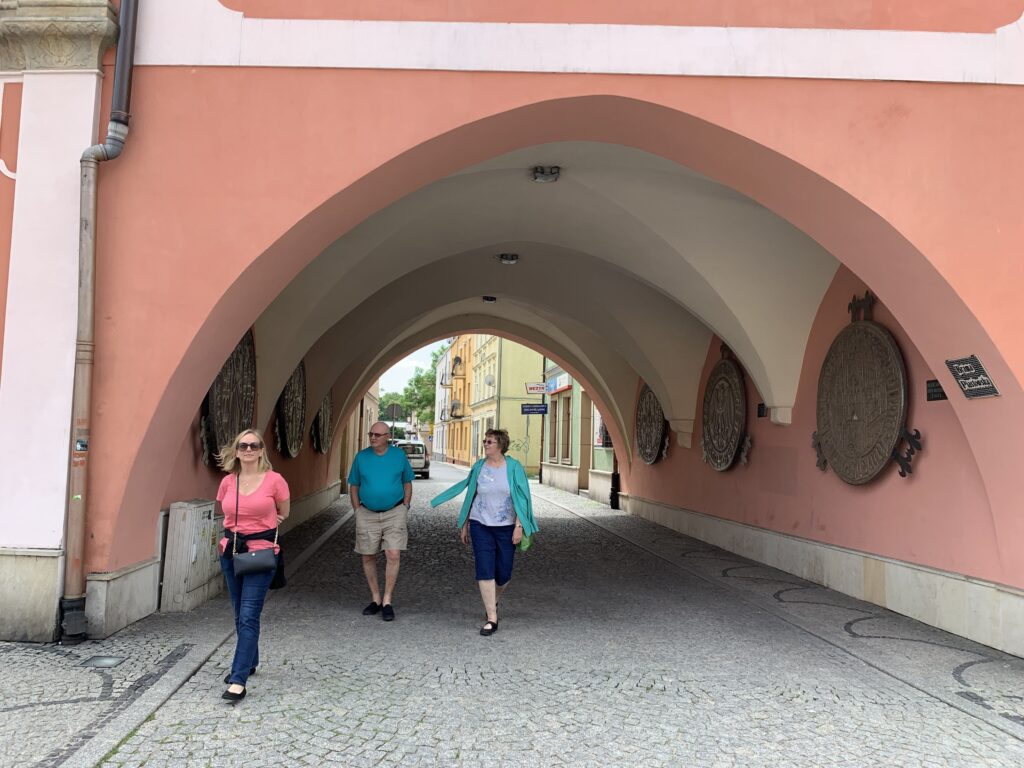
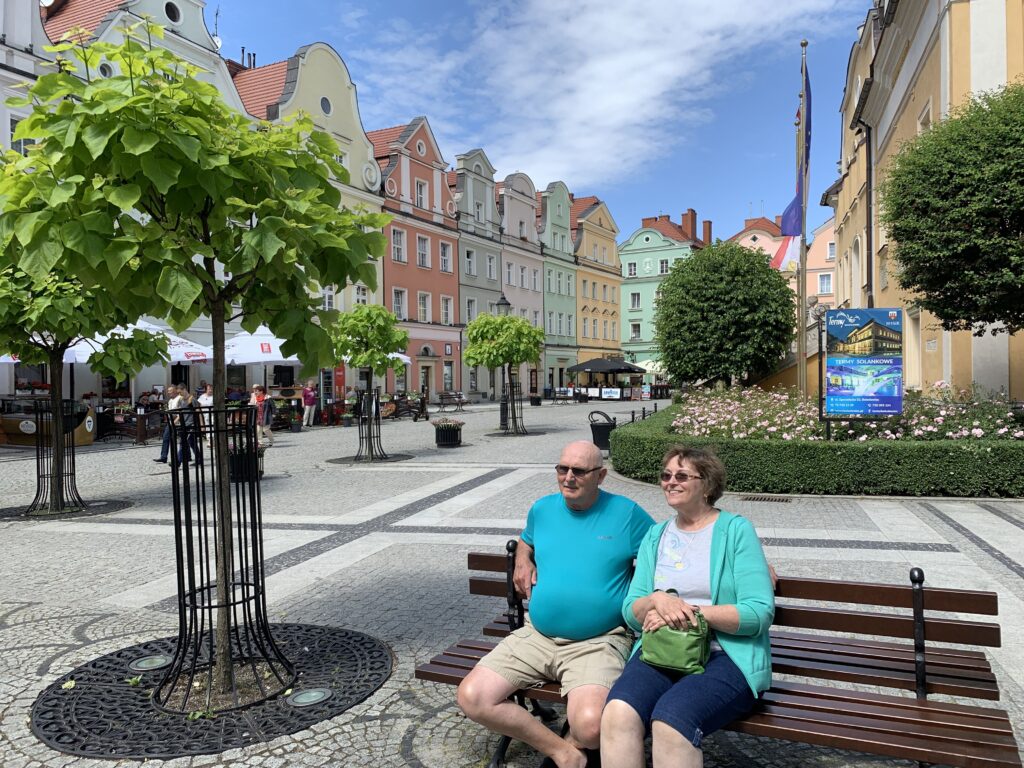
We got there around lunchtime and ate at Restauracja Pod Zlotym Aniolem, the Tavern Under the Golden Angel, at Rynek 29 right on the square.
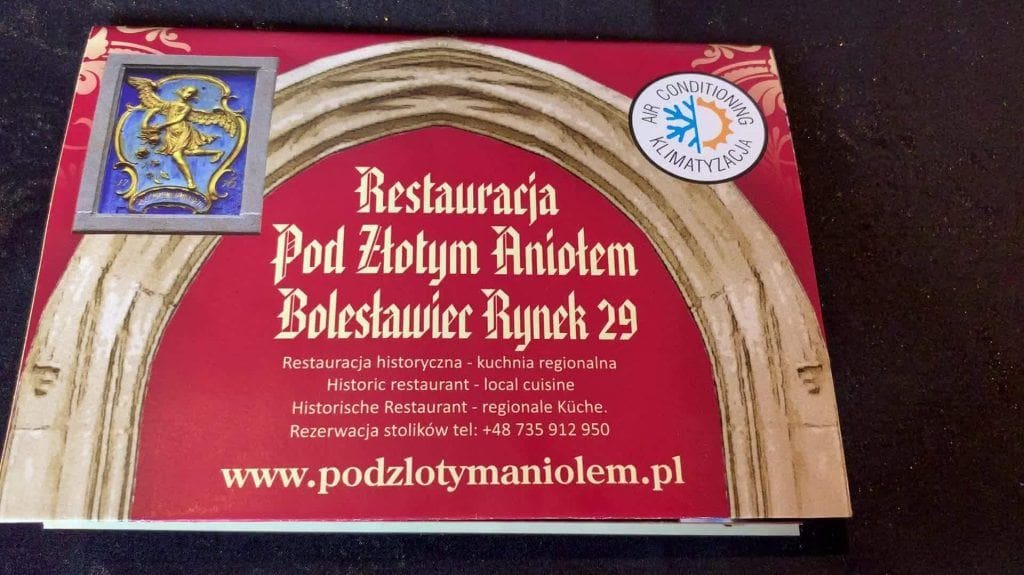
The restaurant’s own story is that Napoleon ate here. Their version is that during the retreat from Russia his sledges needed repairs, and while he waited he ate a meal he couldn’t pay for, so he handed over an ornamental vase from his own collection instead. They say it’s still in the family.
The town’s own news site has taken that story apart. Local historians have Napoleon eating at a different inn entirely, the Black Eagle, and the souvenir he left behind was a teacup rather than a vase. He really did pass through Boleslawiec, several times. The rest of it is the restaurant’s telling and not the historians’. I’m including it because they’ll tell you it over lunch and you may as well know where it stands.
Matt ordered the half duck. It came out on a Boleslawiec plate, which is the correct way to eat in that town.
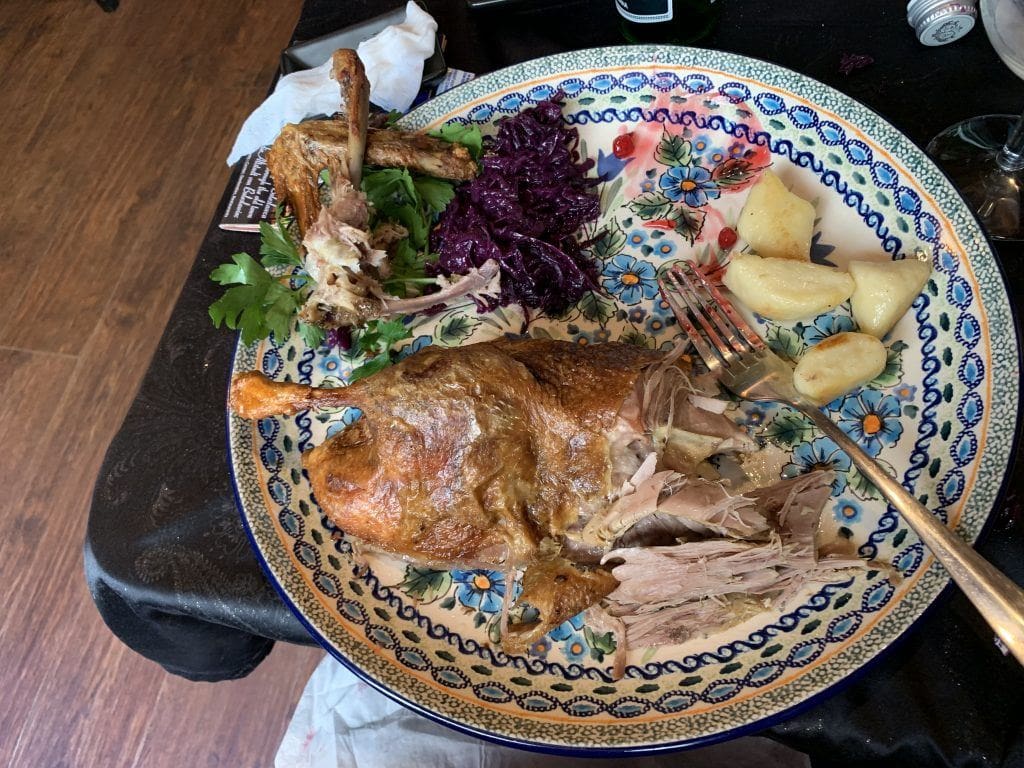
My dad ordered pierogi. It was his first plate of them in Poland and he pronounced them terrible compared to my mom’s. He said the same thing about every plate of pierogi he was served for the rest of the two weeks. My mother has never once let this go, and honestly, she shouldn’t.
The factory stores are the actual reason to come
The square is nice. The factory stores are why you drive there.
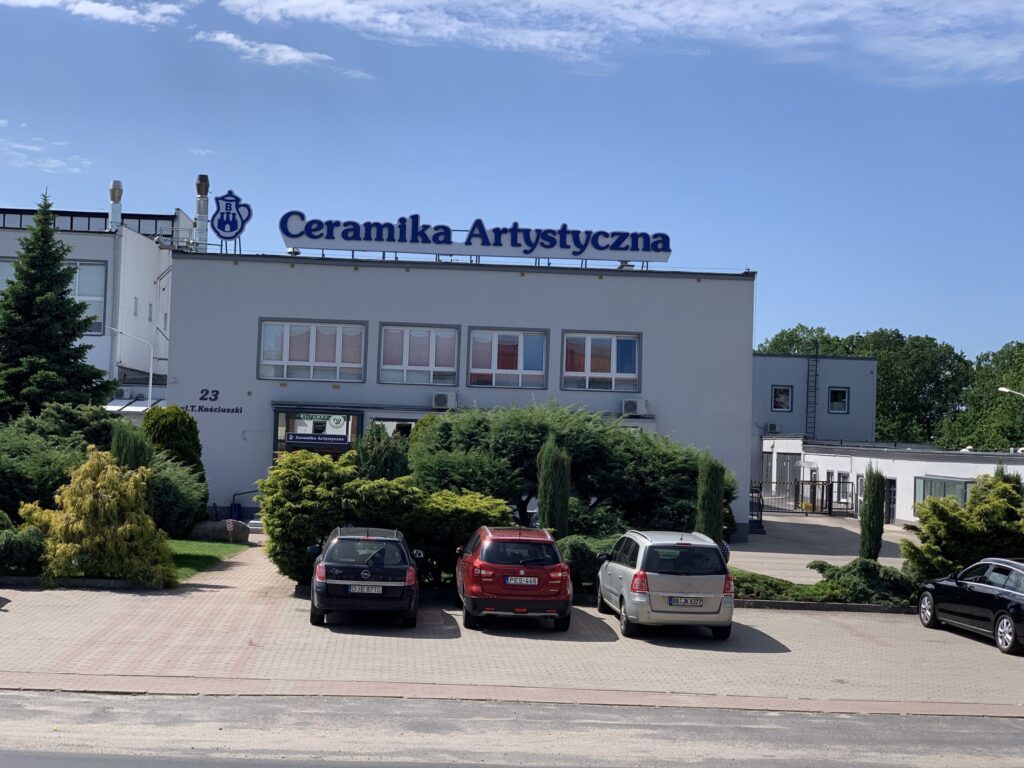
They’re mostly on the edge of town and out along the roads leading away from it. The town’s ceramics museum lists around thirty producers in the area, and most of them sell to you directly. The ones people go to:
Ceramika Artystyczna, at Kosciuszki 23, is one of the two big cooperatives and it’s the one we went to. The other is Zaklady Ceramiczne “Boleslawiec,” which dates back to 1946 and says so at every opportunity.
There’s a strip of shops at Kosciuszki 24B with several makers under one roof, which is the fastest way to compare a lot of patterns without getting back in the car. Manufaktura, over on Gdanska, runs ceramic workshops if you want to make something rather than only buy it, though check what they’re running for adults before you count on it. Andy and Millena are both a short drive outside town.
Hours are the thing to watch. They vary store to store, several close early on Saturday, and some are shut on Sunday while others aren’t. Look up the two or three you actually care about rather than assuming, and don’t build a Sunday around this.
On money: the stores take zloty, euros, dollars and cards, and your change comes back in zloty whatever you pay with. Pay in zloty. The euro and dollar rates the shops use are theirs, not the bank’s, and you’ll lose a few percent for the convenience of not thinking about it.
Here’s what the four of us actually did once we got inside. My mom shopped. I tagged along. Matt took photographs and sat outside in the sun. My dad had a nap in the car.
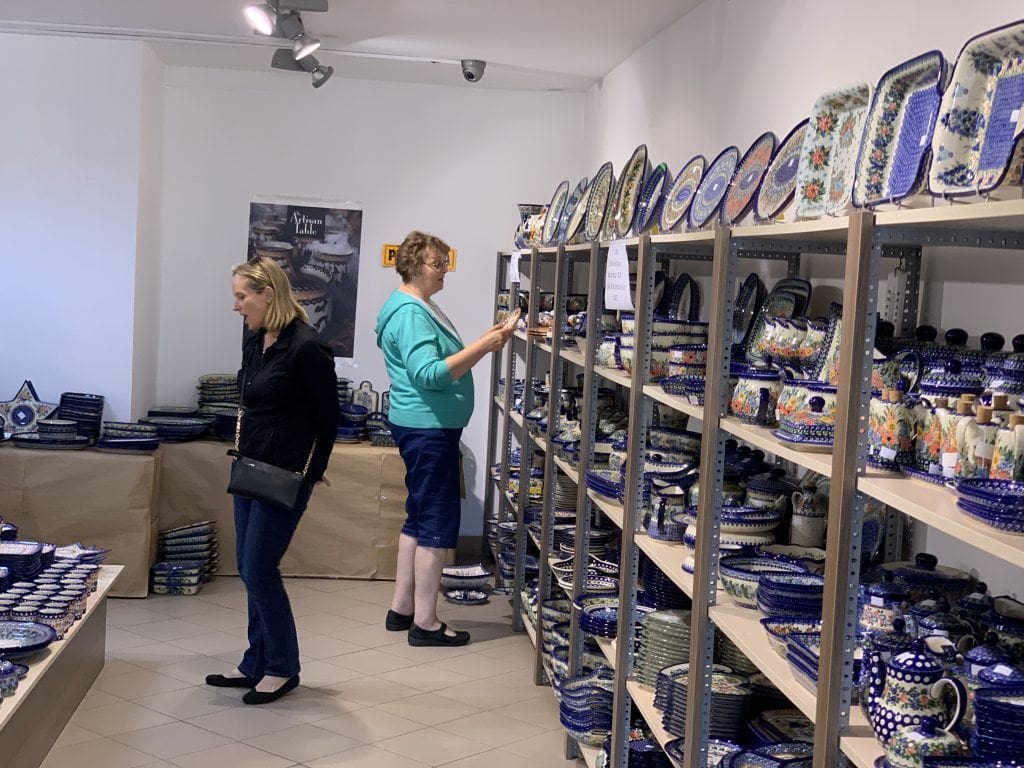
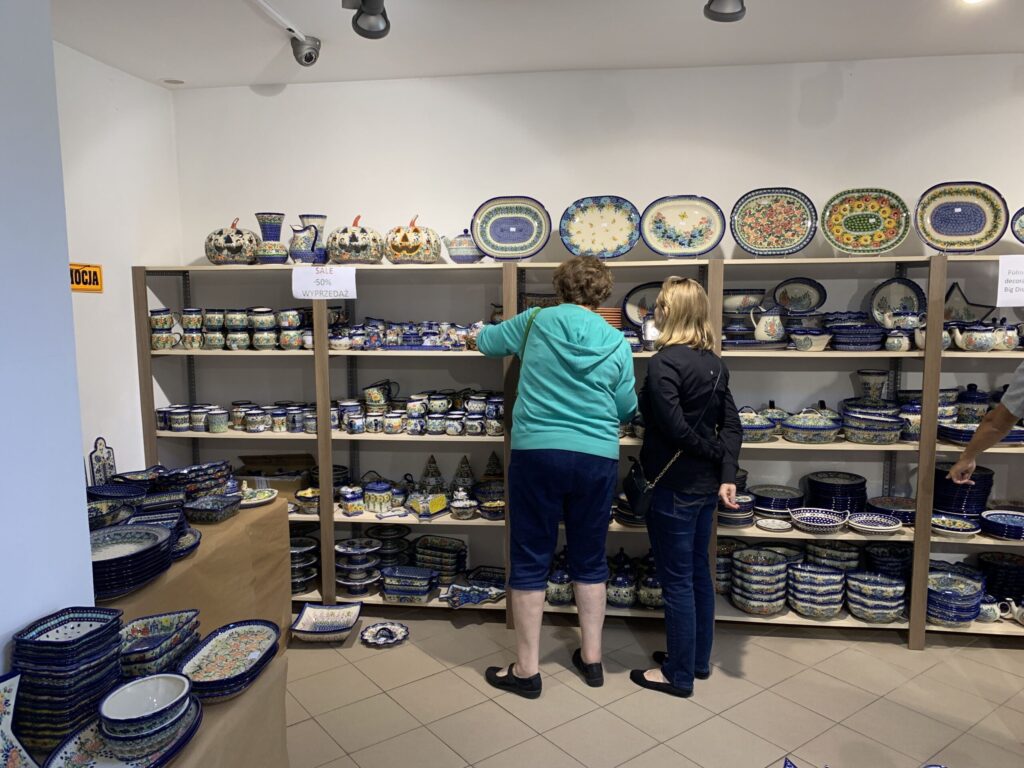
My mom is a walker. She walks as much as she can, every day, and she walked every one of those stores end to end without sitting down once. If you’re going to do the same, wear the shoes you’d wear for a museum day, not the ones you’d wear to dinner. The floors are concrete and the square outside is cobbled. She swears by her Merrells and has for years.
Turn the piece over
This is the one piece of information I wish I’d had before I walked in.
Every piece has a grade stamped on the bottom, written as “Gat” and a number, from 1 to 5. It’s short for gatunek, and it tells you what you’re holding.
Gat 1 is first quality. No flaws. Dishwasher, oven and microwave safe.
Gat 2 has some small imperfection in the brushwork or the stamping. It is still fully usable, still safe for the dishwasher, the oven and the microwave, and it is cheaper. This is where the value is and it’s what I’d buy.
Gat 3 has a real flaw, and this is the one to pay attention to. Keep it out of the microwave, the oven and the dishwasher, and don’t leave it soaking in the sink, because there can be air pockets in the clay that expand with heat.
Gat 4 and Gat 5 are chipped, cracked or decorative only. Fine for a shelf. Not for food.
The other word to know is Unikat. Those are designed and painted start to finish by one of the top artists rather than assembled down a line, and they’re stamped Unikat and signed, with the artist’s initials or her full name depending on how senior she is. They cost more and they’re supposed to.
How it’s actually made
The pattern goes on by hand. An artist cuts the design into a sponge, dips it, and stamps each piece one at a time, then adds brushwork over the top. That’s why two plates in the same pattern are never quite identical, and why the ones with a lot going on cost more than the ones with a simple dotted border.
The clay traditionally came from deposits around the town and it’s high in feldspar and silicon. It’s fired somewhere between 1100 and 1300 degrees Celsius, which is what makes it vitreous stoneware rather than earthenware. That’s the reason it survives an oven and a dishwasher instead of crazing.
The town has been doing this a long time. A Boleslawiec potter shows up in written records in 1380. When this was Prussian Silesia the town was called Bunzlau, and you’ll still see the pottery sold as Bunzlau or Bunzlauer, which is the same thing under its German name. Today the town markets itself as Miasto Ceramiki, the Town of Ceramics, which for once is a slogan that’s just true.
Every August, on the second-to-last weekend, the town throws the Boleslawiec Ceramics Festival. Five days of stalls, workshops and the potteries opening up, and it’s been running since 1994. It’s the busiest week of the year to visit and the best one, depending on what you want out of the day.
The thing nobody warns you about: getting it home
Stoneware is heavy. That’s the whole point of it and it’s also the problem.
A dinner plate that will outlive you weighs what a dinner plate that will outlive you weighs, and six of them plus a casserole dish will eat your baggage allowance before it comes close to filling your bag. Weight is the constraint here, not space, which is the opposite of almost every other souvenir problem.
Matt and I travel carry-on only and this is the one kind of trip where I’d plan around that rather than fight it. Either accept that you’re checking a bag on the way home, or buy less than you want to and be at peace with it. If you want to see how we do the rest of it, that’s in my free guide Lisa’s Carry-On Only System.
Whatever you buy, let the store wrap it. They do this all day. Then pack the wrapped pieces in the middle of your bag with clothes on all six sides, not just underneath, and don’t put anything ceramic against the wheels or the outer edge.
We never did settle what these are
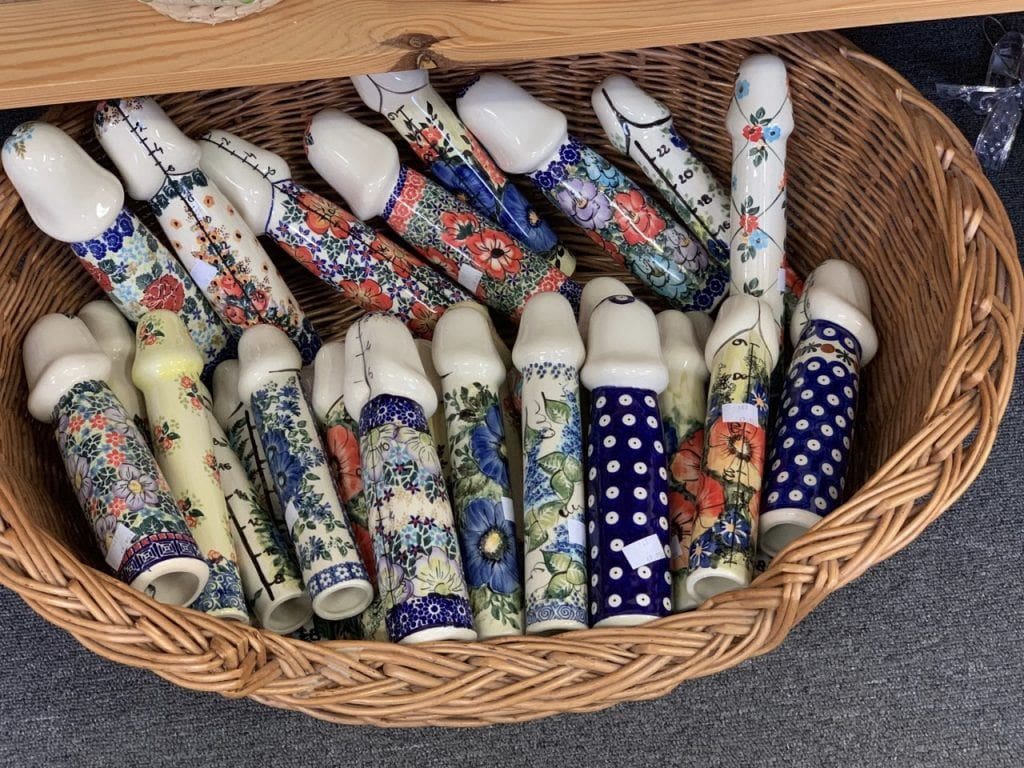
Somewhere in the middle of all this we found a basket of these and had a full family argument about what they were. Salt and pepper shakers? Turkey basters? Something else entirely?
We never reached a verdict and I have thought about it more than I would like to admit.
I am clearly not the only one. Two separate readers have left comments on this post over the years asking which store sold them. Going by the order my photos were taken in, it was Ceramika Artystyczna, though I would not swear to it in court.
If you can’t get to Poland
You can buy the real thing without flying to Silesia. Buy from an importer who names the manufacturer, because there’s a lot of “Polish pottery” for sale that was never near Boleslawiec. If it’s the real thing it’ll say which pottery made it and it’ll have the marks on the bottom. It’ll also cost more than it does at the factory door, which is what you’d expect. Here’s Polish pottery on Amazon.
The bottom line
Boleslawiec is a small town with a pretty square, one restaurant with a Napoleon story it can’t quite back up, and about thirty potteries that are the actual reason to go.
Give it most of a day. Go from Wroclaw if that’s where you are, drive it if you’re already on the road, and check the store hours before you commit to a Sunday. Turn every piece over and look for the Gat number. Buy Gat 2 and don’t feel clever or cheap about it, because it’s the same stoneware. Pay in zloty.
And plan for the weight on the way home, not on the way there.
My mom got to stand in the place her plates come from. That was the whole point of the day, and it worked.
Frequently asked questions
Where is Boleslawiec?
Southwest Poland, in Lower Silesia, near the German border. It’s about seventy-five miles west of Wroclaw, an hour and a half by car and about the same by train.
Is it worth a day trip from Wroclaw?
If you like the pottery, yes. If you don’t, no. It’s a small town and the pottery is the reason to go. Trains from Wroclaw Glowny run all day and take about an hour and a half. Organized day trips take seven to eight hours and most of them add the wooden Church of Peace at Jawor, so check the itinerary before you book.
What do the numbers on the bottom of Polish pottery mean?
They’re quality grades, marked “Gat” 1 through 5, short for gatunek. Gat 1 is flawless. Gat 2 has a small cosmetic imperfection and is still dishwasher, oven and microwave safe, and it’s usually the best value in the store. Gat 3 has a real flaw and should stay out of the microwave, the oven and the dishwasher. Gat 4 and 5 are chipped or decorative only.
Can I really put it in the oven and the dishwasher?
Gat 1 and Gat 2 pieces, yes. It’s stoneware fired at very high temperature, not earthenware. That’s what the town is known for.
Do I need my passport to drive over from Germany?
Yes, and have it somewhere you can reach it. Both countries are in the Schengen area, but as of September 2026 Germany and Poland are each running checks on that border, including at the Olszyna crossing on the A18. The controls run on renewable terms and the end dates keep moving, so check the current position before you drive it.
When is the Boleslawiec pottery festival?
Every August, on the second-to-last weekend, running five days. It’s called the Boleslawiec Ceramics Festival and it’s been going since 1994. Stalls, workshops and factory events, and it’s the busiest week of the year there.
Do the stores take euros or dollars?
They take zloty, euros, dollars and credit cards, and change comes back in zloty regardless of what you pay with. Pay in zloty if you can. The shops set their own exchange rates and they aren’t doing you a favor.
Is Boleslawiec pottery the same as Bunzlau pottery?
Yes. Bunzlau is the town’s German name from when this was Prussian Silesia, and the same stoneware is sold under Bunzlau or Bunzlauer, especially in Germany.
How do I get it home if I’m flying carry-on only?
Honestly, you probably don’t. Stoneware is heavy and weight will stop you long before space does. Plan on checking a bag for the trip home, or buy less. Let the store wrap it and pack it in the middle of the bag with clothes on all six sides. My free guide Lisa’s Carry-On Only System covers how we pack the rest of it.
Is the Polish pottery sold in the US the real thing?
It is if the seller names the pottery that made it. Boleslawiec stoneware from a real importer is the same product from the same town, and it costs more than buying it at the factory store, which is the trade for not flying to Poland. Anything sold as “Polish pottery” with no manufacturer named is worth a second look.
3 comments
What is the store called that sold the ceramic penis?
Hey 2, would like to know the name of the store that sold the Polish pottery penises
Thank you for your information. We are staying in Wroclaw for 6 months this is our 3rd visit to Poland. This will be a nice trip to take on a weekend.