
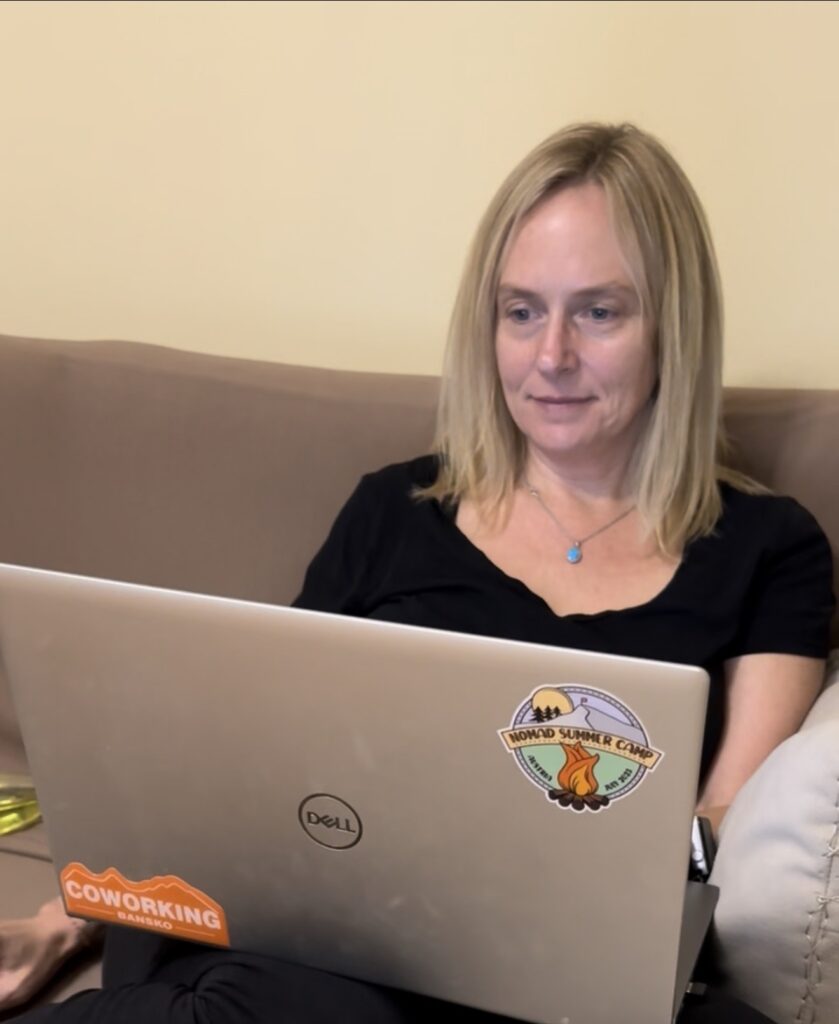

I knew before we ever got out of the car.
We’d been in Penang long enough to extend twice, and when our first apartment was no longer available we found another one a mile down the road, sitting between the two malls with a swimming pool big enough to swim laps in. I do all of our bookings. On paper it worked.
Then the host asked us to meet him a block away from the building rather than at the building.
Then he drove us in under a sign that read NO HOMESTAY.
Then he handed us green cards that said Visitor, and explained that if anybody asked, we were his guests.
Everything in me said no. I said so to Matt. And we went ahead and moved in anyway, because we’d already paid, because the host was reassuring, and because I didn’t want to be the person who blew up the plan over a feeling.
We dropped our bags, had lunch, worked for a while, then changed into our swimsuits and walked down to the pool. There was a padlock on the gate and a sign directing us to the guard station for the key.
So we walked to the guard station in our swimsuits, holding towels, and asked for the key.
The guard said no.
He walked us to the building manager, who started shouting before we’d finished explaining ourselves. He said he had long suspected the apartment was being rented out. He told us there was no version of this where we got the pool key. He also told us, plainly, that he couldn’t throw us out. He just wanted us to know we weren’t welcome.
Our host turned up forty five minutes later looking like he’d been through a wringer. Pale, nervous, apologizing. We could stay, he said. Just not the pool.
We told him we’d be leaving in the morning. He refunded every penny, including the night we’d already slept there, and he looked relieved to do it. We moved the next day into a building down the road that allowed short-term stays openly, and it turned out to be gorgeous.
It was my birthday.
Here’s why I still tell that story years later. The listing was real. The host wasn’t a criminal. Nobody had cloned the photos or taken our money and disappeared, which is the kind of thing everyone means when they say Airbnb scam. I had done what most people think of as due diligence and I still ended up standing in a lobby in a swimsuit being shouted at by a stranger.
The thing that goes wrong with a rental is almost never the thing you were checking for.
Before we go any further, though, I want to say the obvious thing: I’d book another one tomorrow, and I probably will.
We’ve stayed in hundreds of Airbnbs. Penang is the story I tell because it’s the outlier. The apartment we moved into the next morning was better than the one we lost, and I’ve booked constantly in the years since. This isn’t an article about why you shouldn’t rent an apartment. It’s the short list of things I check first, so you end up in the good ones.
The question almost nobody asks before booking
Most of us vet a listing for whether the place will be nice. Will the bed be comfortable, is the neighborhood safe, do the photos look real.
Almost nobody asks the question that actually got us: is this rental even allowed to exist?
Short-term rentals are legal in most places but banned in a few. And separately from anything the city says, individual buildings set their own policies, which means an apartment can be perfectly legal in the eyes of the law and still be forbidden by the people who run the building it sits in.
The platforms leave this to the host. If a host quietly decides not to comply, nothing in the listing will tell you. You find out when somebody knocks.
The law typically punishes the host rather than the guest, but you don’t want to be anywhere near that situation, and the practical risk to you is simpler than a legal one. It’s that you’re standing on a street in a foreign country at four in the afternoon with your suitcase and nowhere to sleep.
That’s a solvable problem. It’s just not solvable at four in the afternoon. It’s solvable three weeks earlier, with three questions.
The three questions I ask every host now
I send these before I book, through the platform, in a friendly message. A good host answers them easily. That’s the entire point.
1. What are the local rules on short-term rentals here?
I’m not asking the host to be a lawyer. I’m watching how they respond. A host who says “they’re legal here, this is a registered rental, here’s the registration number” has told me everything. A host who gets vague or changes the subject has also told me everything.
2. Are short-term rentals allowed in this specific building?
This is the one that would’ve saved us. Legal in the city and allowed in the building are two completely separate questions, and the second one is what puts a guard between you and the swimming pool.
3. How do the other residents and the building management feel about guests?
Even where it’s legal and permitted, some buildings are openly hostile. You’re allowed to know that in advance. I’d rather stay somewhere slightly less nice and be able to say good morning to the person at the front desk.
If any answer makes you uneasy, follow up. And say plainly that you’ll expect a full refund and will describe the situation in your review if there’s a problem. That sentence changes the conversation.
What the reviews would’ve told me
Hosts have an interest in their own answers, so the questions are only half of it. The other half is sitting in the reviews, and it isn’t in the star rating.
There’s a search bar inside the reviews. Use it, one word at a time.
For the problem that got us, search these nine: quiet, discreet, security, guard, front desk, key, pool, gym, neighbors.
Then read what comes back with one question in mind. Did anybody mention actually using the pool or the gym? Did anybody mention a friendly word with the front desk? If a building has amenities and no guest has ever mentioned using them, there’s a reason for that.
And if you find a review saying “remember to stay quiet” or “don’t mention Airbnb,” you’re done. I’ve seen both of those in real listings. That isn’t a quirk. That’s a guest politely describing the exact situation we walked into.
Those nine words are for one specific problem. There’s a longer list for everything else you’d want to know about a place before you book, and a reason this works at all that’s worth understanding, and both of those are in the ebook.
The red flags that are actually red flags
Plenty of what gets called an Airbnb red flag online is just internet anxiety. These are the ones I take seriously.
A host who coaches you to lie. Meet me a block away. Say you’re my friend. Be discreet. All three of those were said to us in Penang, and I’ve never once regretted walking away from a booking after hearing anything like them. A good host explains check-in and tells you where the good coffee is. A good host doesn’t brief you.
Any suggestion to pay or talk outside the platform. This is the only rule in this article with no exceptions. A host who offers you a better price for paying directly is either scamming you or removing every protection you have, and from where you’re sitting those look identical until it’s too late. Book on the platform, message on the platform, pay on the platform.
A price far below everything else nearby. Twenty or thirty dollars under the neighborhood is a deal. Hundreds under is a question. Rentals operating where they shouldn’t be are often priced to fill fast.
A thin review history. My rule of thumb is that under fifteen reviews deserves real scrutiny, and zero is a no unless I’m out of options. That isn’t a judgment on new hosts. Reviews are simply the only independent information you have.
And for the times when everything checks out and something still feels slightly off, I travel with a portable door lock. It weighs almost nothing and it means I never have to spend a night deciding whether I trust a lock I didn’t install myself.
The one minute habit that has saved us the most money
In southern Spain we found an apartment with water views listed at $2,200 a month. We were ready to book it.
Before I hit confirm I ran the listing photos through Google Lens. The search took me straight to the property manager’s own website, where the identical apartment was $1,695. No platform service fee, no third party charge.
That was over $500 saved in under a minute, and I’ve done it again and again since.
Here’s why that gap is there at all, and I know this side of it because we rent out an Airbnb ourselves. The same apartment is often sitting on three or four sites at once, and every one of them takes a cut. Airbnb charges the guest a service fee and charges the host one too. VRBO takes more from the host, so hosts often set a higher nightly rate there to make up the difference. Booking direct skips all of it. You aren’t getting a special deal. There are just fewer people taking a piece.
I want to put that next to what I said earlier, because the two sound like they contradict each other and they don’t. A host who messages you asking to move the payment off the platform is a red flag, every time. You finding the property’s own website and booking there is a different thing entirely. The difference is who went looking, and whether the business you’re paying is one you can actually find, with a real address and a real phone number.
I don’t book direct every time, though. For one or two nights the savings aren’t worth the extra steps. And if a place has no reviews, or anything about it feels off, I book on the platform and pay the fee on purpose, because the platform is what I’d be calling if it went wrong. For a week or longer, direct is almost always better.
When you do book direct, ask what’s included before you pay. Taxes, cleaning, parking. Those are the three that turn up at the end.
The terms differ as much as the prices do, so before you book anywhere, check Booking.com as well, because the cancellation and pay-later terms are frequently the friendliest and that matters more than people expect. If you’re traveling on short notice, Whimstay is worth a look for last-minute pricing.
And there’s a second way to move the number, which is to just ask. Talking a host down on the rate or the fees is a different skill from finding the same place cheaper somewhere else, and it’s worth having both. That one is in my free guide How to Negotiate Airbnb Prices and Fees.
Why almost all of it goes right
I’ve spent this article on the ways a rental can go sideways, so let me put it back in proportion.
If I had to put a number on it, ninety-nine out of a hundred of our stays have been genuinely great. Not fine, not survivable. Great. Balconies we didn’t want to leave, kitchens I cooked in for a month, neighborhoods we still talk about. That’s the actual experience of booking apartments, and it’s why we’ve kept doing it for years.
The reason nearly all of them go well isn’t luck, and it isn’t some instinct I have that you don’t. It’s that by the time I hit confirm, the place has stopped being a gamble and become a decision. I’ve asked the questions. I’ve read the reviews for the words that would give it away. I know what I’m walking into, which is a completely different feeling from hoping.
And that part changes faster than you’d expect. Once you know what you’re looking for, searching stops being the nervous bit and turns into the part of the planning you actually enjoy.
What you still can’t tell from a listing
You now know how to find out whether a rental is allowed to exist, and how to make a host tell you the truth about it. That’s the part nobody writes about, and it’s the part that got us.
Here’s the part that wouldn’t fit on this page.
Every listing you will ever look at is eight photographs and a paragraph, written by somebody who wants you to book it. Reading those photographs is a skill, and at this point it’s most of what I actually do. Where the bathroom door isn’t. What the mirrors are telling you about the size of the room. Whether there is anywhere to put your clothes for three weeks. Whether that kitchen can cook a meal or only reheat one. Whether the sofa seats the number of people you’re bringing.
The No-Regrets Guide to Booking Airbnbs the Right Way is that skill written down, and the nine steps around it. How to search from the map instead of the list. What the reviews tell you if you read them for patterns rather than stars. How to check the host. What the fine print does to the price you thought you were paying. And what order to do things in when something does go wrong, which is the difference between the platform sorting it out and you paying for your own replacement apartment.
It’s built over hundreds of stays and written from both sides, because we rent out an Airbnb of our own. It isn’t a list of things to be afraid of. It’s how you find the good ones on purpose.
And once you’ve booked it, the other half of this is in my free guide The First Ten Minutes in an Airbnb: the quick pass you run at the door, before you unpack, that decides whether a small problem stays small.
And once you’re in, the handful of small things I carry so a rental starts feeling like mine is in How to Make a Hotel Room or Airbnb Feel Like Home.
The bottom line
The apartment that went wrong for us wasn’t a scam and it wasn’t a bad apartment. It failed on a question I didn’t know to ask.
That’s really what all of this is. Not paranoia, not a horror story collection, just a short list of questions asked in the right order, three weeks before you go, when the answer still costs you nothing.
Ask the host whether the rental is legal and whether the building allows it. Search the reviews for the words that would give it away. Walk away from anyone who wants you to lie or to pay off-platform. And when your gut says something is wrong, believe it the first time.
Almost every time, nothing will be wrong and you’ll book somewhere you love. That’s been our experience for hundreds of stays. The questions aren’t there because renting an apartment is risky. They’re there so you can stop wondering and go enjoy it.
Frequently asked questions about booking a rental safely
Is Airbnb still safe to use? Yes, and I use it constantly. We’ve lived in short-term rentals most of the year for years. The risk is real but it’s small and mostly avoidable. What isn’t safe is booking on the photos alone.
Can you actually get evicted from a rental? It happened to us in Penang, though what really happened was subtler than eviction. The building manager told us plainly he couldn’t throw us out. He simply made it clear we were unwelcome and that we’d never get access to the pool we’d booked the place for. We left the next morning. That’s the more common version of this: not a dramatic removal, just a stay that becomes unlivable.
How do I know if short-term rentals are legal where I’m going? Search the city name and “short-term rental rules” before you book, then ask the host both questions: is it legal here, and is it allowed in this building. The second one is the one that catches people.
How many reviews should a listing have before I trust it? Under fifteen gets real scrutiny and zero is a no unless I’ve run out of options. Reviews are the only independent information you get, and without them you’re trusting the host’s own description of the host.
A host offered me a discount for paying directly. Should I? No. Never. It’s either an outright scam or it strips away every protection the platform gives you, and you can’t tell which from the outside. Pay on the platform.
What if the host cancels on me at the last minute? It has happened to us. In London we got a full refund from Airbnb and still lost money, because we had to book a last-minute replacement at a much higher price and the exchange rate had moved against us in the meantime. Refund doesn’t mean whole, which is why the cancellation terms are worth reading properly before you book rather than after.
Is Booking.com safer than Airbnb? Not safer, but often more flexible. Booking.com tends to have the friendliest cancellation and pay-later terms, which matters more than people realize when plans aren’t fully settled.
What if my gut says no but everything checks out on paper? Don’t book it. I ignored mine in Penang and spent my birthday standing in a lobby in a swimsuit. Your gut is quietly processing information you haven’t consciously named yet, and there’s always another apartment.
Subscribe to my newsletter!
I send one email a week. Real stories, what worked, what didn’t, and the practical things I only figure out by doing them. Plus my free packing guide and international travel checklist when you sign up.

2 comments
Comments are closed.