
The question I get most about packing cubes isn’t whether they work.
It’s about the compression ones, and it’s always some version of the same thing: there’s no pump and nothing to suck the air out, so what exactly is being compressed, and do the clothes come out wrinkled?
Fair question.
Compression cubes don’t work like vacuum bags (although I’ve seen those in the ‘As Seen on TV’ section of stores and assume they’re a gimmick). They simply have a second zipper that squeezes the cube down and smushes the clothes tight. So a compression cube just makes the bundle smaller, and the clothes come out no more wrinkled than they went in. For me that’s the right trade: I get some space back without the gimmick.
So before anything else, know which of the two you’re buying, because they are not the same product.
Some links on this page are affiliate links. We may earn a commission if you use them. See our Affiliate Disclosure.
The only distinction that really matters
Regular packing cubes are about organization and nothing else. They don’t make your clothes smaller. What they do is stop your suitcase from turning into one giant pile, so you can find a dress without unpacking everything above it.
Compression cubes do that same job and then add the second zipper. That zipper is worth real space on sweaters, knits, leggings, and anything soft and bulky that’s holding air it doesn’t need.
If you travel in linen, or in anything else that creases easily, compression is going to make that worse and you should stick with regular cubes. My travel wardrobe is deliberately mostly wrinkle-free at this point, which is why compression works for me. If yours isn’t, buy the regular ones.
What compression will not do
Compression will not make your bag lighter. If anything, filling the space they save makes your bag heavier.
So if your airline strictly weighs carry-ons, and plenty of them do, squeezing your clothes smaller could take you over the limit. Compression buys you volume. Weight is a separate problem with a separate solution, which is packing less stuff. And that’s exactly what my free Travel Clothes Packing App is for. Use it to create a carry-on only packing list.
How to pack packing cubes
This took me the longest to figure out, and it’s why I won’t travel without cubes now.
Most people load a cube with shirts, a cube with pants, a cube with underwear, like your dresser drawers. It seems logical but it falls apart the moment you’re actually on a trip, because a shirt and the pants that go with it are now in two different places.
I pack by when the clothes are coming out of the bag instead. The stuff I’m wearing this week goes in the cubes on top, easy to reach. The stuff I’m not wearing until the beach part of that same trip gets compressed flat and sits at the bottom of my bag. That way I don’t repack the suitcase. I just swap which cubes are on top.
That’s how I carried two seasons in one carry-on this fall. We were in Italy in a heat wave, decided on the spot to spend two weeks in Norway, and my summer clothes never left the bag. They just moved to the bottom, compressed down, out of the way. My sundresses rode the whole trip in their own cube under everything else. In Norway I only opened two of my four cubes.
And don’t overstuff them. I learned that one the hard way. It’s worse with a compression cube, because now there’s a second zipper to fight, and wrestling that thing shut gets you nothing but sore fingers. If the zipper is a struggle, take something out.
The wider version of this, the whole system with the capsule wardrobe and the three pairs of shoes, is in my free guide Lisa’s Carry-On Only System. This page is about the cubes themselves.
Leave one of them empty
When you pack at home, leave one cube completely empty. That’s where dirty clothes go for the rest of the trip.
Without it, worn clothes end up shoved back in with clean ones and no one wants that. With it, the dirty pile is contained, it goes straight into the laundry when you get somewhere with a machine, and you never have to sniff a shirt to find out.
Thirty seconds to unpack
The packing isn’t really why I use cubes now. The arriving is.
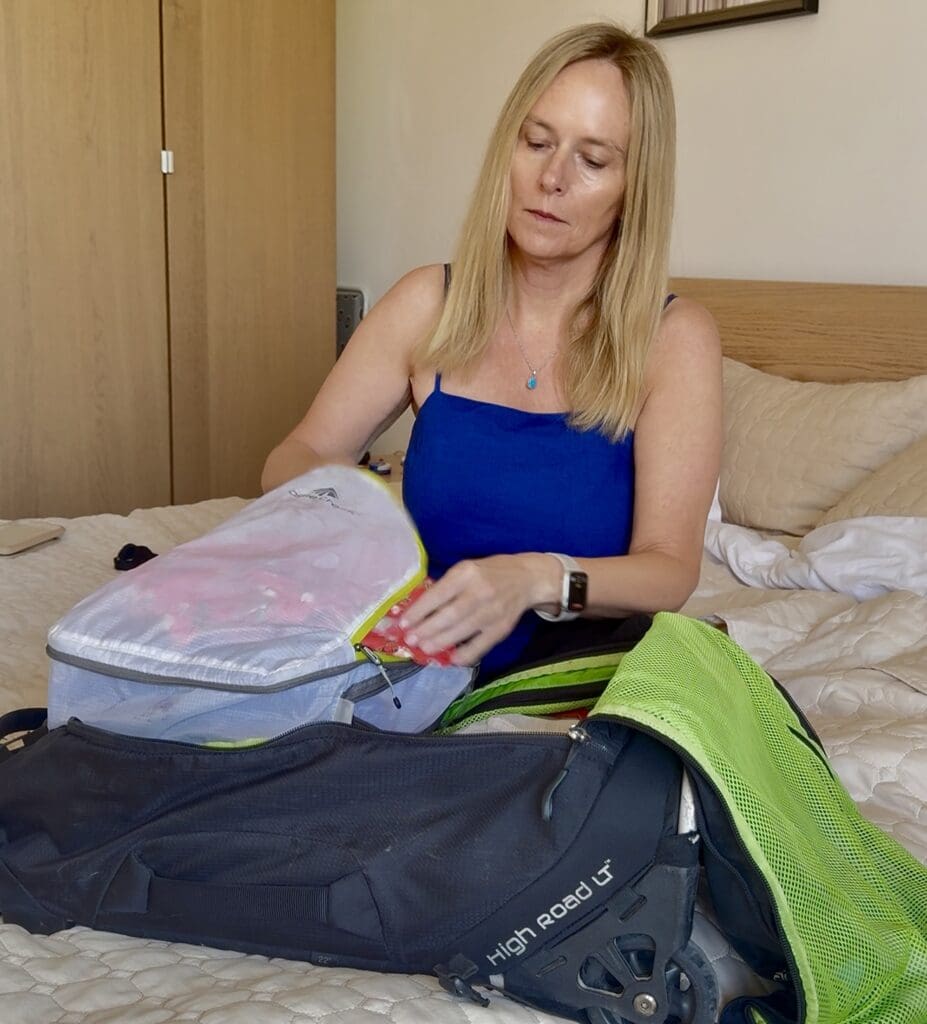
I pull the cubes out of the suitcase, put them in a drawer, and I’m unpacked. When it’s time to go, they come out of the drawer and go back in the bag. Call it thirty seconds either way.
If you’re on one trip to one place, that’s a nice-to-have. If you’re moving every three or four days, which is how a lot of trips actually go, it’s the difference between settling in properly and living out of an open suitcase on a luggage rack because unpacking feels like too much effort for two nights.
Buying your first set
Cubes come in small, medium and large, and the sets are usually sold as some mix of the three.
I want a bit of structure in the walls, so the cube holds a shape and my clothes stay a neat block instead of settling into a lump. I want a mesh top so I can see what’s in there without opening it. I want a zipper that feels like it’ll survive a few hundred trips, because the zipper is the only thing on a packing cube that can actually break. And I want them sized so a small one fits in my personal item as well as my suitcase, since that’s where I put a change of clothes in case my carry-on gets gate-checked.
These are the ones I use. And here’s a regular version if you decided against compression a few paragraphs ago. The rest of what goes in the bag alongside them is on my packing essentials list.
How many do you need
I travel with five, four packed and one empty, and that doesn’t change whether I’m gone for two weeks or two months, because I pack about the same either way.
That number gets asked a lot and I don’t want to hand you a rule, because it depends entirely on how you split your clothes up. Start with a set of three or four, use them for one trip, and you’ll know immediately whether you want another one. What you don’t want is eight cubes, because at that point you’ve just built a smaller, more expensive version of the pile you were trying to avoid.
Frequently asked questions
Do packing cubes save space? Regular ones don’t. Compression ones do, on soft and bulky clothes. Both save you time, which is the real reason to use them.
Do compression cubes wrinkle your clothes? Less than you’d think, because they’re not vacuum bags and they don’t pull all the air out. But if you’re packing linen or another fabric that creases easily, yes, compression will make it worse, and regular cubes are the better buy for you.
How many packing cubes do I need for a carry-on? Three or four is a sensible place to start. I use four, plus one for dirty clothes.
Should I pack cubes by clothing type? I don’t. Shirts in one and pants in another means you’re opening two cubes to get dressed. Pack by when you’ll wear things instead, and keep what you’re not wearing yet zipped up and out of the way.
Are packing cubes worth it if I only take one trip a year? Yes, but for a different reason. On a single trip to a single hotel the organization matters less. What you’ll notice is that packing at home gets faster and repacking to come home stops being a chore.